
In WW II, Lieutenant Aubrey Harold Pringle, known as ’Jock’, served in the Australian Imperial Force with the Australian 8 Division’s 2/18 Battalion in Malaya and Singapore.

On 10 February 1942, as the invading Japanese forces neared Singapore city, Jock was drafted into a scratch unit of 200 men, known as X Battalion, drawn from survivors of the much depleted 2/18, 2/19 and 2/20 Battalions, which had been ravaged during the initial assault on the island by the Imperial Japanese Army on the night of 8 February.
Towards dusk on the afternoon of 10 February, in an effort to hold back the Japanese, the unit received orders to advance to high ground between Jurong and Reformatory Roads, near Bukit Timah, an area that none of the members of X Battalion knew and which would soon be in darkness. As they passed through Bukit Timah village, now a mass of flames, they learned that the enemy was just ahead. Having had no sleep for the past three days, everyone was extremely tired. After making their way through terrain littered with the bodies of hundreds of dead Indians, the Australians headed towards their designated position, a trig station known as Jurong I. However, they were unaware that the Indians on their right had not arrived and another scratch battalion, Merritt Force, pushing its way through swamp and jungle, had holed up for the night to their rear, making X Battalion the most forward of the units supposed to take part in the attack.
Darkness found them some five or six miles from the start point for the intended assault, so it was decided to move to the rendezvous point in easy stages. Contact with other troops involved in the attack was maintained by wireless up until midnight when, for some unaccountable reason, contact was lost. X Battalion, still moving forward, was not aware that there had been a change of plans by Malaya command, and that the objective was not to be attacked.
After a forced march the men reached their position at around 1am and were instructed to get some sleep until called to action. As Indian troops were between them and the enemy and, as the fighting had died down, it was considered quite safe. Having marched all night, all were soon fast asleep.
The first indication that something was amiss was the sound bursting grenades as the Japanese charged the position a couple of hours later. Taken completely by surprise, many panicked and raced right into devastating fire, now pouring in from all points.
Very few survived the onslaught. Many of those not cut down in the initial charge were captured and, later that day, lined up along a monsoon drain and used for sword and bayonet practice by Japanese troops advancing along Jurong Road. Some, however, managed to escape encirclement, including one group, led by Lieutenant Pringle and Captain William Richardson, of 2/20 Battalion.
The two officers were friends. Both came from Sydney, had served with the militia in the Sydney University Regiment and had enlisted in the AIF on the same day. Their service numbers were only two digits apart. A third friend, who had also joined up the same day, had stood between them.
As they attempted to reach Allied lines, they heard voices speaking in English ahead. Thinking they were the Indian troops, Richardson and Pringle advanced with a party of eight, only to find it was a trap – the voices came from a Japanese command post. Richardson shouted that he was all right but for the others following to ‘scram’.
Unlike their comrades who had murdered the captives on Jurong Road, these Japanese did not harm or mistreat their prisoners. Instead, they set the rank and file to work digging ditches as protection against shellfire. A senior Japanese officer, after handing Pringle a cigarette, began questioning him and Richardson.
However, the post came under attack by shell and mortar fire, killing at least two Japanese and the two Australian officers. The surviving prisoners continued to be well cared for and, when the Allies surrendered, they were transferred to the Changi camp.
Pringle and Richardson were presumed dead, killed on 11 February. It was not until hostilities ceased in August 1945 and Australian recovery teams began to search for their war dead that the remains of the two men were found, buried in a shallow grave beside a small track on the side of a hill, not far from where X Battalion had been ambushed. As the bodies of the officers had not been buried by their comrades at the time of death or months later, when gangs of POWs were allowed a day to locate and inter remains still scattered over the vast battlefield area, it is believed that the Japanese had carried out this task.
The two friends are now buried side by side in graves 32 B 1 and 2 in Singapore’s Kranji War Cemetery.
On exhumation by the recovery team, there was no indication that the pair had been executed, and in the 1990s any notion that this may have been the case was dispelled by two of the party, captured at the same time but who had survived the friendly fire and the war. However, on reading a book on the history of 2/18 Battalion published in 1991, which revealed that Jock Pringle had been captured and that, according to the book’s author James Burfitt, ‘it seems likely that Pringle was executed soon after questioning’, Pringle’s sister took this unsupported statement as fact. Assuming that he had indeed met this grisly fate, she informed the media in 2002, on the 60th Anniversary of Singapore’s fall that her brother ‘had his head cut off – it’s in the book’. Although I informed her that there was not a shred of evidence to suggest this was the case, the story persisted for another 20 years, and was passed to the next generation.
On dispelling the story a second time in 2025, I learned from a Pringle family member that that in 2017 an Australian officer’s tunic jacket, marked under the pocket flap with Jock’s army number NX35009, had been purchased by an Australian tourist from a market in Japan. The tunic was in excellent condition, with the brass ‘rising sun’ and ‘Australia’ badges intact, along with all the buttons and lieutenant’s pips on the shoulder tabs. On the upper arm of the jacket the distinctive green and purple felt colour-patch of 2/18 Battalion, was vibrant and pristine. The person disposing of it, possibly a family member of a Japanese veteran or collector, evidently had no idea of its rarity or significance.
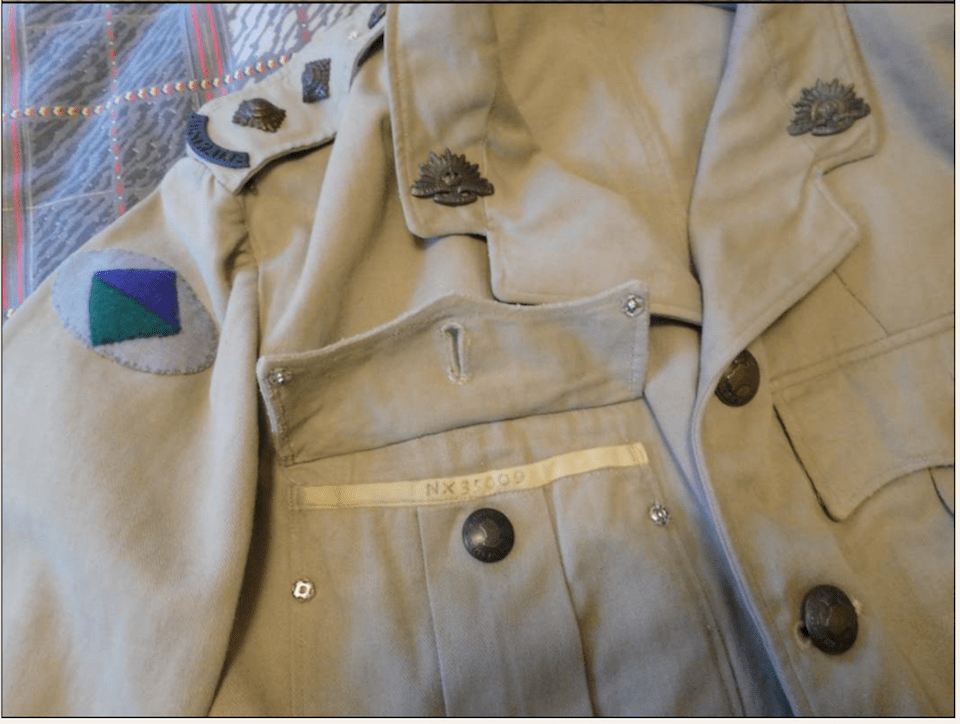
As Jock Pringle had been killed on 11 February 1942, the fact that his tunic had turned up in Japan 80 years later, and in such fine condition, prompted the anonymous Australian buyer to post photographs on an internet site in order to find out how this may have come about. While his correspondents marveled at such a find, none could offer an explanation.
https://www.worldmilitariaforum.com/forums/index.php?/topic/319302-australian-military-tunic/
The answer, however, is very simple.
Clothing of those in action was collected from the AIF storage facility in Singapore and taken to Changi camp after the Allied surrender. Any surplus clothing, belonging to deceased personnel or not needed by others, was available to those left only with the clothes they were wearing.
Any surplus clothing was sent by the Japanese administration in Singapore for distribution to POWs working in camps outside Changi.
Note: These ‘hand-me-downs’ cause confusion post-war when recovery teams located the remains of a prisoner of war, clad in clothing that did not belong to him.
Pringle’s tunic, therefore, could have reached Japan in one of two ways.
1) An Australian lieutenant in need of a tunic took the one belonging to Jock Pringle from the Changi clothing pool and was then sent with a working party to Japan. As the garment was festooned with highly desirable badges, insignia and brass buttons and was in excellent condition, the new owner may then have swapped or sold it for food, money or medicine, to a Japanese guard or soldier, who kept it as a souvenir.
2) Some clothing sent to POWs working outside Singapore did not reach the intended recipients. In Sandakan, British North Borneo, it was appropriated by the Japanese and given to local workers at the airfield to wear at the big opening ceremony. A Japanese soldier posted to Sandakan or to any of the POW camps outside Singapore may well have helped himself to a tunic that was worth souveniring and took it back to Japan with him at war’s end.
Mystery solved!