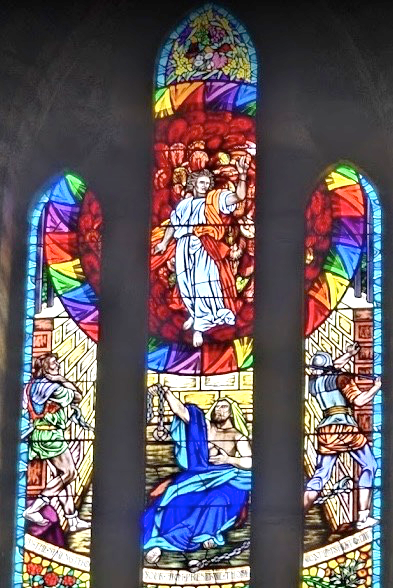
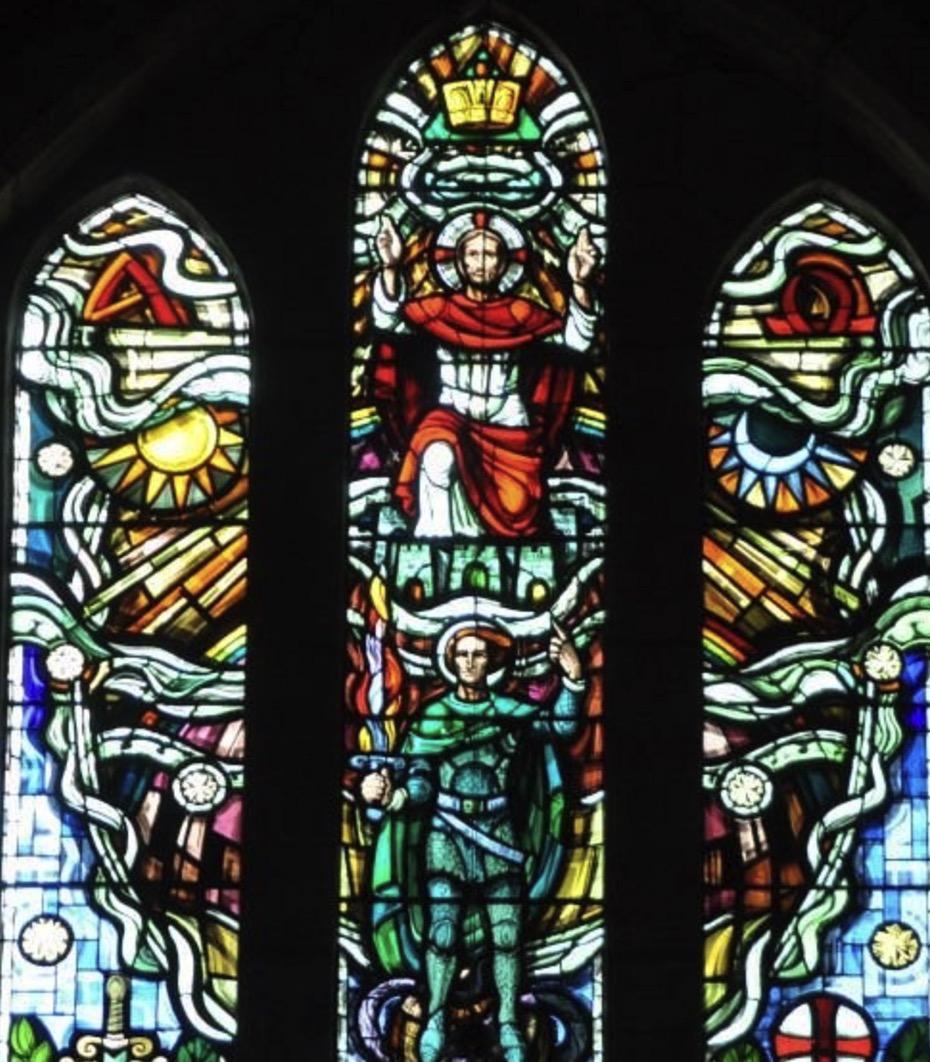
The rather dark and forbidding east window in Sandakan’s St Michael’s Church, Sabah, with a warlike St Michael the Archangel as the central figure, was commissioned privately as a memorial to the son of two parishioners. Installed in 1970, the work was unsigned and the name of the artist forgotten until 2004, when stained glass artist Philip Handel, who created the magnificent Remembrance and Friendship windows on the west wall, identified the creator as Sydney-based Stephen Moor, who was keen on symbolism, dark colours and abstract design.
Although working in Australia post-war, Moor was born in Hungary to German parents. At the time of his birth on 22 September 1915, Stephen’s father, a third-generation military man and an officer in the Austro-Hungarian army, was serving on the Croatian front.
Stephen’s first language was German but, as he was raised in Budapest, he also spoke fluent Hungarian. His given name was Stefan and the family name was actually Mohr but, in around 1936, his father changed it to Moor, as it was difficult for anyone with a German, Czech, Croatian or Serbian name to advance in the Hungarian public service, enrol at university or serve in the military.
Always interested in drawing from the age of three or four, Stefan was a poor student in his early teenage years, which he spent at a conventional high school. However, he became more focused at the age of 14 when his father transferred him to Pan, a private art school. He later studied under impressionist painter Stefan Szonyi, before obtaining an art diploma from the Royal Academy of Fine Arts in Budapest. Although secretly a frustrated fashion designer, he began creating stained glass, mosaics and murals for clients in Germany and Hungary. He also taught at the Budapest Academy.
After receiving a scholarship to study in Rome, he was preparing to leave when World War II erupted. Drafted into the army, he fought with Nazi Germany, firstly with an anti-aircraft unit. This was followed by two years spent in the Ukraine on armoured trains supplying the Russian front, where he was involved in actions against partisans severely hampering the German war effort by repeatedly blowing up the main rail line leading to Orel. Partisans rounded up and captured were summarily executed and a village supporting them destroyed in retaliation, along with its inhabitants. An estimated 1370 Ukrainian villages suffered the same fate, with death tolls ranging from 600 to more than 6000.
However, the partisans were uncowed and when the German forces were finally forced to retreat, Moor returned to teaching in Budapest at a German-language school, but it was not long before he was mobilised and obliged to don a uniform. This time, however, though the auspices of his former general, he was assigned to the high command, well away from the front line, where he painted anti-Russian and anti-communist propaganda posters. In 1945, with the unforgiving Russians approaching from the east, the high command was moved further west and Moor was fortunate to be at Berchtesgaden, in the American zone, at war’s end. After making his way to Saltzburg in Austria he was reunited with his family.
They all returned to Germany. For the next five years, as a displaced person, Stefan lived in the small town of Nürtingen, which had survived the war unscathed, working at a studio in nearby bomb-damaged Stuttgart, repairing and restoring stained glass windows. In 1947 he married Editha Hoffman. Although born in Freidwaldau in what was Czechloslovakia, she was now classified as German. Nine years his junior, Editha was the first of three wives, the second being Margo, an Australian, and the third, Charlotte, who was German Swiss.
Refused admittance to America because he had served in the enemy’s armed forces, Moor applied for entry as a Hungarian refugee into Australia, which was seeking European migrants to augment those from the UK in this post-war reconstruction period. However, he was rejected when he stated his occupation as ‘artist’. Undeterred, he immediately lined up again, registering as a ‘glazier’. This time he was accepted, given an identity number and, about three months later, Stefan, aged 31, and Editha were on their way to Australia. His widowed mother, Else, remained behind in Munich. As a contracted ‘worker’ now claiming no particular skill, Stefan was under obligation to work for two years in any job at any location deemed suitable by the government’s Department of Labour.
His first real sight of his new homeland was from the deck of the crowded refugee ship SS Nelly, when he reached Melbourne on 29 September 1950, the Feast of St Michael known as Michaelmas, a date that may have had some bearing on his decision to design the east window of St Michael’s Church. However, he kept no record of his commissions, and never signed his stained glass windows as he did not like, or was not proud of, much of his work.
After transiting through the migrant camp at Bonegilla in Victoria, Stephen and Edith, as they were now known, were sent to Sydney’s Broughton House Migrant Hostel in Burwood. The next day Edith began work in an underwear factory. Her husband was assigned to Sonnerdale’s factory on Sydney’s Parramatta Road where, as he had said he was a ‘painter’, he refurbished and repainted large rusty gearboxes. To break the monotony, he depicted scenes on the inside of many of the casings, which earned him the nickname ‘the artist’.
The pay was good but Moor, a right-winger politically, was sacked for refusing to join a union because of his anti-communist feelings. After a few months spent just enjoying life and with his actual profession now established, he joined P O Barnard’s Standard Glass studio, but moved in 1952 into his own studio, a tiny shed in Spencer Road, Mosman, on Sydney’s north shore. He relocated to Burwood Road, Burwood, the following year, and then to Liverpool Road, South Strathfield, where he created both traditional and modern designs, seemingly favouring sombre colours. The lead-lighting firm Bolton Glass, which rented space in his Strathfield studio, assembled his windows, including the window for St Michael’s, completed in late 1969. He named his business Ars Sacra (Latin for sacred art), which caused much amusement among Australian suppliers and clients, who subverted it to a crude form of insult. However, despite the ridicule, Stephen stuck with his choice, spelling out the name rather than saying it, and advertising mostly in the Catholic press.
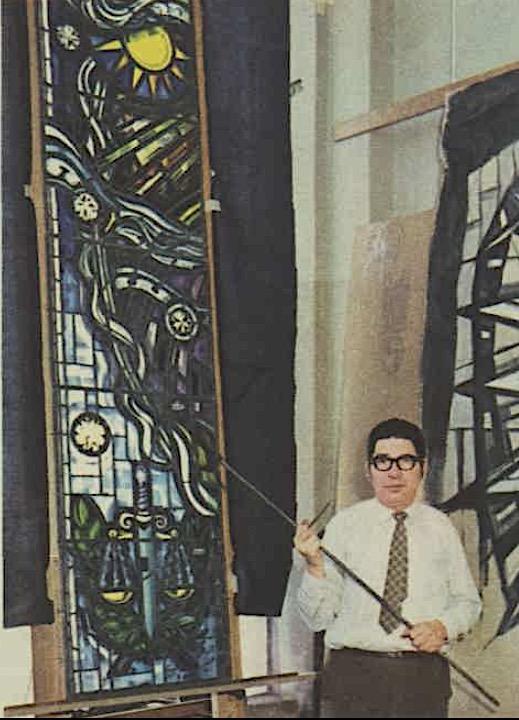
In addition to stained glass, Stephen was a painter, and a designer of church fittings, sculpture and architectural glass walls. While he believed that stained glass was integral to architecture, post-war Australia had not embraced a modernist approach to architecture as had Europe. Critical of Ashwins, one of Sydney’s large stained glass studios employing seven or eight artists, he derisively stated that ‘It was all factory-like. All standardised. All uniform—all what people so falsely called traditional. And whatever people—even intelligent people—call traditional, it’s not a tradition of good stained glass. It’s a tradition, a mistaken tradition of the 19th Century—but not a tradition that one would call a tradition of good design in rhetological art of stained glass.’
Interestingly, while Philip Handel was not a fan of Moor’s ‘modern’ designs or his workmanship, Philip, a traditionalist, came to Moor’s attention in the 1950s.
In an interview in the 1980s, he revealed that ‘there were only one or two men trying to do something like stained glass. There was a young man called Handel.’
Philip Handel was certainly young. His father Alfred, a stained glass artist of fifty years’ experience, had died when Philip, who was apprenticed to him at age 14, was only 17. Alfred had worked at the influential Lyon Cottier and Company and was so highly regarded as the firm’s best stained glass artist that, when it closed, the equipment, including a gas-fired kiln dating back to 1873, a large workshop table, easel and tools, were gifted to Alfred, who then launched out on his own.
Alfred’s work, which was highly esteemed, was not without controversy. One design in particular, a magnificent rose window, was described as ‘too bold’ by the architect installing it, while another, who saw this creative boldness as brilliance, stated that
‘Mr Handel had that rare quality of spiritual insight. He knew the bible from end to end. He understood the characters depicted. He felt, within himself the meaning of the subjects he portrayed. That is why his work has that elusive, almost intangible quality which can kindle the emotions of the beholder until he feels as Mr Handel felt when he designed it.’
Moor, on the other hand, was unaccountably very dismissive of Alfred’s work, describing him as a ‘very, very bad maker of windows’. Nevertheless, he admired Philip’s ‘guts’ in taking over his father’s studio, and receiving his first big commission aged only 26 – the huge, 13-light, west window of Victoria’s Sale Cathedral. When Moor asked Philip how he knew what he was doing, he replied that since the age of fourteen he had watched his father and saw how he did it: ‘Raised from the cradle for stained glass’, as he later put it.
hilip not only inherited his father’s skill as an artist who worked in the medium of stained glass, he also inherited his spiritual insight and a deep understanding of the message to be portrayed, talents that make his work stand out from so many others. This is especially true of his beautiful Windows of Remembrance, which have an indefinable quality that few can emulate.
Philip had an intensely personal connection to the prisoners of war who died at Sandakan. His much older sister was engaged to one of them. Moor, on the other hand did not. He had fought against Britain and her empire with Nazi Germany in World War II, witnessing and participating in atrocities. It is therefore somewhat ironic that he received a commission for the east window of St Michael’s Church, damaged by fire from Allied bombs in June 1945 but restored and dedicated as a war memorial church to honour the 2,500 Allied POWs who had died in Sandakan.
Handel’s and Moor’s designs and the quality of workmanship on their windows in this historic, stone war memorial church, one on the west wall and one on the east, are poles apart. Moor’s rather dark designs, with a confusion of symbols and an over-abundance of plane, geometric shapes filling the space beyond the central design, so evident in the east window, and in two of the images below, were influenced by German expressionism, the simplified shapes and planes of Picasso, abstract expressionism and ethnic art. Devoid of any feeling, they fail to evoke any emotional response, as they lack ‘soul’. And, while some of his windows and glass walls use brighter colours, his traditional stained glass lacks the joyous light of Handel’s creations.
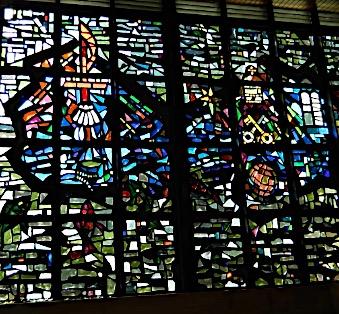
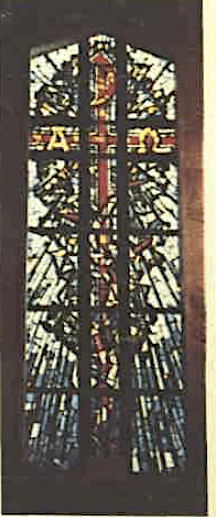
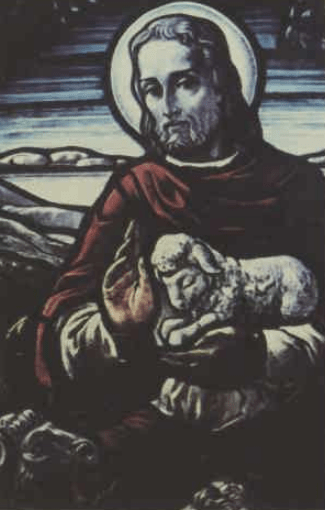
Examples of Moor’s work
Philip Handel, however, was so very like his father Alfred. As a man of great faith and a committed Christian with a profound understanding of his subject, he did not create his windows for art’s sake.
A labour of love, they are windows from the heart.
Perhaps this is what makes all the difference.